|
|||||||||||||||||||
|
|
Dr. Idinga ist Militärarzt der tanz. Armee und besuchte
die |
||||||||||||||||||
|
Kitandililo – An African Case Kitandililo is a Tanzanian village that is experiencing both the first and third world. It is coming to age in a nation of peace that is still experiencing the difficulties inherent to the African continent. At the same time, the vestiges of neo-colonialism are introducing the village to the ways of the West. Kitandililo’s people, forever changing, are following a snaking path to a promising future. Located at about 8.5 degrees south latitude and 35 degrees east longitude, Kitandililo is in an equatorial region dominated by what geographers call tropical savannah. Situated on the central African plateau, the average elevation of the area upon which the village is situated varies between 1600 and 1800 meters which experiences cold winters and intense winds (Gemeindepartnerschaft, pp. 1). As a whole, Tanzania has a set rainfall pattern. “Rainy seasons extend from November to early January and from March to May. (Tanzania, pp.2)” These climatic conditions have set up an interesting background picture on which the Tanzanian social order has been established. Tanzania’s culture is one of the oldest in the world. The cultures of its native pastoral inhabitants (Masai); Arab traders, especially those from Oman; the people of India and China; and Europeans, particularly Portugal, Germany, and England (Tanzania, pp.2) have influenced it. The largest influences have, by far, been the Arabs who even went as far as establishing the capital of Oman on the Tanzanian island of Zanzibar (Tanzania, pp.2)! Tanzania was also influenced by its German colonizers between 1886 and 1918, and even today, Germany remains one of Tanzania’s main trading partners (CIA). Religiously, Tanzania is evenly split between Muslims, Christianity, and indigenous faiths (CIA). Something of primary interest is that these faiths have not clashed as seen in many others countries of the world. This last point is especially interesting given that the country’s population density as referenced to arable land is 936 persons per square kilometer (CIA)! The overall picture of Tanzania is bleak compared to that of Western developed nations and it is in this context that the Church Partnership of Kitandililo and Ismaning/Unterfoehring is working. The partnership between the Lutheran churches in these two towns, Kitandililo, Tanzania and Ismaning/Unterfoehring, Germany, was established in 1989. The mission of the partnership is to improve the living conditions of Kitandililo and to reduce the time needed for Kitandililo to develop to meet modern, Western standards while still protecting the culture of Kitandililo (Gemeindpartnerschaft, pp.2). This partnership is undertaking their calling by gathering donations of tools, clothing, medical equipment, school supplies, literature, and money. Both of these villages are working diligently to alter, yet preserve, the lives of those in Kitandililo. The people of Kitandililo are of Bantu decent. Due to the colonization and neo-colonization of the area, the village is largely Lutheran by faith. By reading multiple correspondances, one concludes that the people highly regard the pastor of the church, “On Sunday (sic) we are going to discuss with the pastor about the visit of Mr. Gross… (09/03/02).” The political system of the area is therefore made very interesting. As understood through discussions with the German side of the partnership, there is no mayor in control of Kitandililo as there would be in the United States; instead, there is a council that administers a larger area in which Kitandililo is only a part. The people have a de facto local leader that is religious! The populace of Kitandililo is also very astute regarding education. Every youth goes through primary education and many adults go to evening classes to learn how to read and write both Swahili, the native language, and English. “…The parents who have (sic) 35-45 [years] they try to find educatio (sic) Adults Institution and other place (sic) where they can get [an] education. (17/3/2002)” The people of Kitandililo have a very interesting mentality, one that is further morphed by its current conditions. Kitandililo is in no way a monetarily wealthy town and the condition of the town reflects that. To begin, the buildings use homemade bricks; little concrete, no steel, very little wood. The reason for the limited use of concrete and steel is that both products must be brought from over thirty miles away and are expensive specialty items Everything in the region is transported by hand or bike because it is cost-prohibitive to own a truck and to maintain such a vehicle. The average income of Kitandililo is rarely measurable by the number of Tanzanian Schillings in the hands of the people. Instead, the value is often measured by the number of cattle and other livestock that one owns; in Kitandililo, many people share cattle while possessing multiple chickens and pigs. . At the moment, the partnership is undertaking a Livestock Improvement Program in which money is raised for the Lutheran Church in Kitandililo to purchase a variety of livestock and to train a breeder. The ultimate goal of this project is to make the village wealthy by livestock standards. Another sign of prosperity in a region is the quality of medical care provided. In Kitandililo the primary causes of illness are: Malaria, Upper Respiratory Tract Infections, Pneumonia, Diarrhea related diseases, Somms Infestation, Skin diseases, Eye infections, Urinary tract infections, and Dental infections (Evangelical). Providing medical care for Kitandililo are Dr. Hosiana Mgaya, midwife Mary Mangula, auxiliary Rhoda Njogola, cashier/laboratory attendant Julius Mtenzi, and night watchman Peter Ngapemba. The dispensary at Kitandililo is able to provide the following services: birthing, emergency dental, family planning, laboratory, minor surgery, prenatal care, and pediatrics. The village treated 2,638 patients in the year 2001. If looking at just medical care as a sign of wealth, Kitandililo would be a prosperous village. The reason for the high quality of medical care in Kitandililo is directly due to the huge investment of the partnership. The German congregation provides almost 25% of the operating budget of the dispensary. The village of Kitandililo is, with the help of the German partnership, planning for future development. This development mirrors the modest goals of many on the African continent. First, “We are planning to extend the dispensary to [a] Health Centre. (Evangelical)” This shows the first and foremost of the African goals, to improve physical welfare of the people. Another goal of the village as a whole is to provide electrical power from the dispensary to the church and communal warehouse. They would also like a telephone line; however, currently the village is making due with laptop computers owned by the pastor of the Lutheran congregation and the doctor. Other wishes are simpler, such as more books for the schools. In time, the surrounding six primary schools would like to develop a library along side the dispensary. Currently, extended aid in Pennsylvania is providing a complete Encyclopedia Britannica and yearbooks dating from the 1960s. The village would also enjoy more basic materials such as typewriters, bicycles, and sewing machines. The people in Kitandililo are always pushing forward and their plans for the future project this wish to advance in the globalized society of the world. “…Our dispensary becomes powerful of others of the remote area like this. (Evangelical)” The people of Kitandililo are forever advancing through the difficulties of their inherent position in the world. Faced with the ever-changing environment that surrounds them, the people are persevering and developing at a remarkable pace. The village of Kitandililo is a shining beacon for the African continent and is a clear case study as to the life and development of an African village. NACH OBENKitandililo – An African Case Bibliography Berenick, Kihombo. Letter. Kitandililo Lutheran Church; P.O. Box 1088; Makambako, Tanzania. 17/3/2002. Dr. Mgaya, H.N. Evangelical Lutheran Church in Tanzania-Southern Diocese Makambako District. The report of Kitandililo Dispensary since it started in 1993. Kitandililo Lutheran Dispensary, Kitandililo, Tanzania Dr. Mgaya. Letter. Kitandililo Lutheran Dispensary; P.O. Box 1088; Makambako, Tanzania. 07/02/02. Dr. Mgaya. Letter. Kitandililo Lutheran Dispensary; P.O. Box 1088; Makambako, Tanzania. 09/03/02. Foerderkreis Tanzaniahilfe. America Online. 11/18/02. www.tanzaniahilfe-ismaning.de. Krankenstation/Dispensary in Kitandililo/im Hochland von Sued-Tansania. America Online. 11/18/02. www.hilfswerk-z.de/Proj_Kitandililo_Tanzania.com. Rowntree; Lewis; Price; Wyckoff. Diversity Amid Globalization. Prentice Hall, Upper Saddle River, New Jersey, 2003. Sandolph, Flonbu E. Letter. Tanzania. America Online. 11/5/2002. www.geographia.com/tanzania. Tanzania. America Online. 11/18/02. www.cia.gov/cia/publications/factbook/geos/tz.html. Wurm, Friedemann; Majewski, Dietlinde; Dr. Mgaya, H.N. Die Gemeindepartnerschaft von Kitandililo und Ismaning/Unterfoehring. Evangelische Kirchengemeinde Ismaning/Unterfoehring, Ismaning/Unterfoehring, Bayern, Bundesrepublic Deutschland. Note: Several of these documents were in the German language and therefore several of the quotes are not of literal translation but are instead the authors’ best rendition of the information. |
|||||||||||||||||||


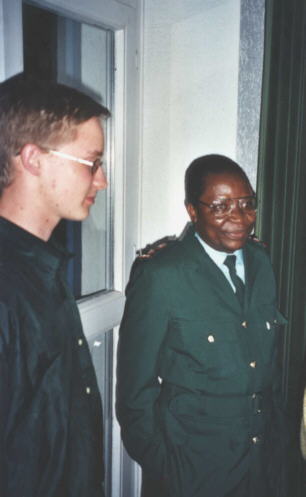 Dr. Idinga mit Karl Deren.
 NACH OBEN
|
||||||||||
|
Spendenkonto der Evang. Kirchengemeinde: Verwendungszweck
Kitandililo VR-Bank Ismaning IBAN: DE02 7009 3400 0000 4039 20 Bitte wenden Sie sich an das Evang. Luth. Pfarramt Gabrielkirche Ismaning - Rafaelkirche Unterföhring EMail des Pfarramts |
||||||||||
|
Pfarrer Carsten Klingenberg Pfarrer Julian Hensold |
Dr. Schmitt Str. 10 | 85737 Ismaning |
Tel.: 089 - 96 65 66 |
Fax.: 089 - 96 202 567 |
||||||
| Dekanate | Anschriftenliste | Bücherliste | Bildergalerie | Linkliste | Sitemap | Impressum | ||||
|
|
||||||||||